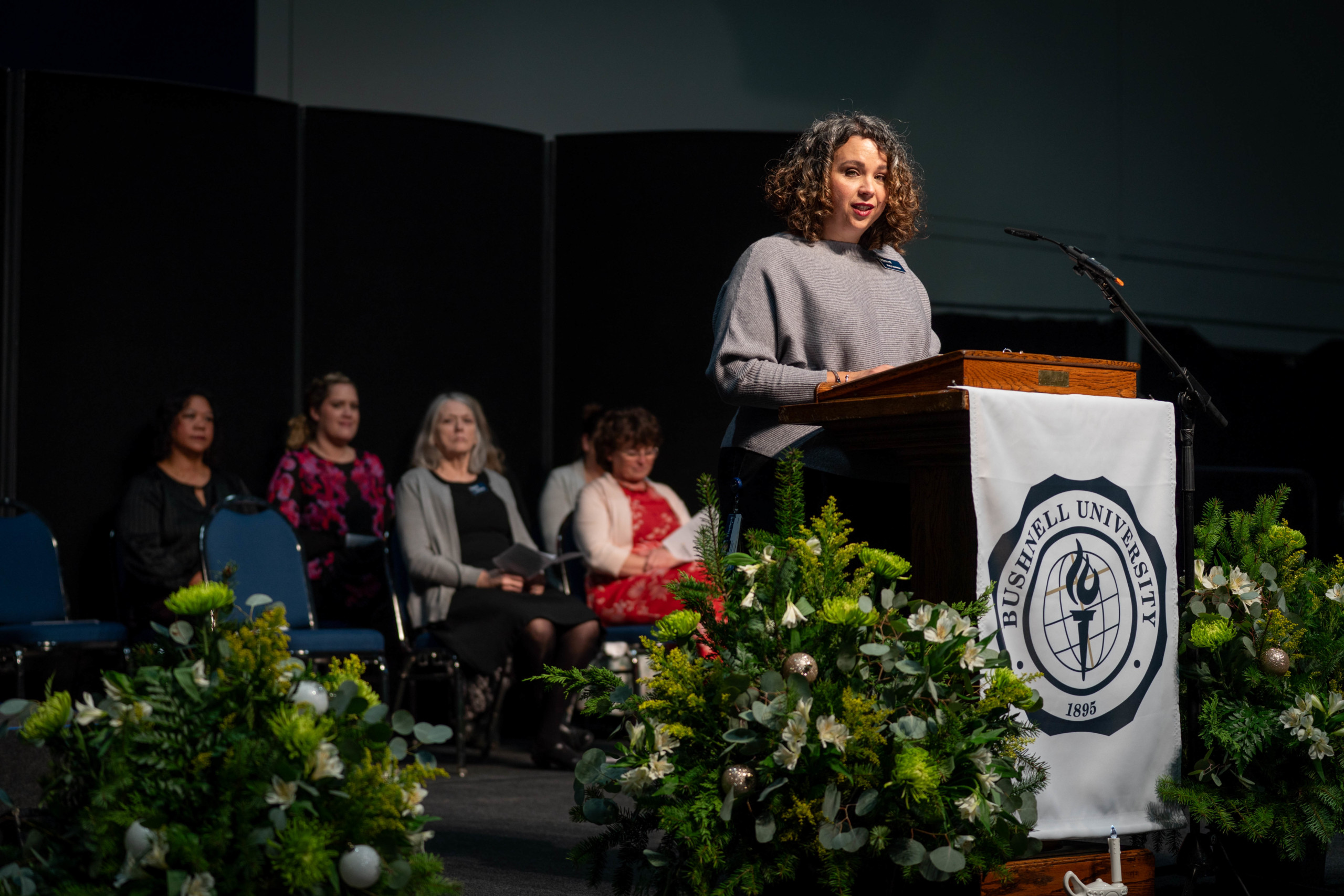
When Katy Lemieux reflects on how she arrived in the classroom, she often returns to an unexpected phone call. While working as a nursing supervisor, her charge nurse abruptly asked whether she had a bachelor’s degree and then hung up as soon as she answered yes. Minutes later, the charge nurse called back: “I have a job for you.”
That conversation resurfaced a long-standing promise Lemieux had made to herself. After being denied admission to nursing school twice due to limited instructional capacity, she had vowed that one day she would teach. “I just didn’t anticipate it would be this early on in my career,” she says. But the opportunity felt unmistakably right. Soon she joined Bushnell University’s Accelerated Bachelor of Science in Nursing program, where she now serves as an assistant professor of nursing and the director of nursing.
Lemieux brings to Bushnell more than a decade of clinical experience working as a registered nurse in the Eugene–Springfield community, including work in emergency care, oncology, endoscopy, day surgery, and hospital supervision. She holds both her BSN and MSN from Western Governors University, along with earlier degrees from Lane Community College and the University of Oregon. Yet her teaching draws not from degrees alone, but from the everyday discipline of paying attention to people and meeting them where they need to be met.
We caught up with Lemieux to hear more about her approach to nursing education, her reflections on the formative role of caregiving, and the guidance she offers students as they navigate the demands and rewards of their training.
Teaching with Presence and Mutual Respect
Each new cohort has its own personality, she notes. Learning how a group responds, engages, and supports one another shapes how she approaches the classroom. She compares it to walking into a patient’s room: “Every patient you have a little bit of a different personality to engage with them. It’s the same thing with the cohorts.”
That attentiveness guides her instruction. She wants students to recognize her expertise, but also to understand that she continues to grow as an educator. “I have a lot to give them,” she explains, “but at the same time I want them to know that I have a lot to learn from them too.” Building mutual respect is essential — and, for her, the foundation of a learning environment where students can thrive.
Faith and caregiving intertwine naturally in her understanding of nursing. She describes moments of holding a patient’s hand, praying when asked, or simply sitting with someone in their most vulnerable hours. These acts are not ancillary, she tells her students: they are the heart of the profession. “Nursing is caregiving. That’s what we do.” Their ability to care with compassion is, in her words, “our superpower.”
Lemieux also speaks candidly about the emotional dimensions of practice. Nursing is deeply selfless, but also “selfish” in the sense that meaningful care fills the caregiver’s own spirit. Those moments of connection — joyful or heartbreaking — bring what she calls “soul-satisfying gratification.”
Her ongoing sense of calling to Bushnell mirrors this interplay of service and fulfillment. She laughs when admitting that she has formally resigned twice, only to return each time. “I keep trying to leave here. I keep getting called back,” she says. The only explanation she offers is simple: “God. This is where I’m supposed to be.” Within Bushnell’s close-knit community, she has found the sense of belonging that is often elusive in large hospital settings.
Community, Formation, and Advice for Students
For students stepping into the intensity of an accelerated nursing program, Lemieux offers one clear piece of guidance: lean into community. Cohorts, she observes, naturally bond under the weight of shared challenge. “They’re kind of just in this endless cycle of learning and busyness, and they really learn to take care of each other,” she says. Those relationships last long beyond graduation.
She encourages students to practice self-care while also contributing to the wider community, knowing that service often renews the one offering it. Whether volunteering, supporting classmates, or extending compassion in clinical settings, students learn that care, given and received, shapes both professional identity and personal growth.
For those pursuing nursing, she offers a reminder born of her own journey: the work is demanding, but she cannot imagine doing anything else. Even on the hardest days, she says, “I get to say every day I go to a job I love. Not many people get to say that.”
Learn More
Lemieux teaches and leads within Bushnell University’s School of Nursing, where students prepare for meaningful, compassionate practice grounded in clinical excellence and whole-person care. To explore the ABSN program and other nursing pathways, visit Bushnell University’s School of Nursing website.