Written by Miranga Cyr, Eugene Register-Guard
Even as sections of the former PeaceHealth University District hospital are demolished, one part of the campus is getting a second life.
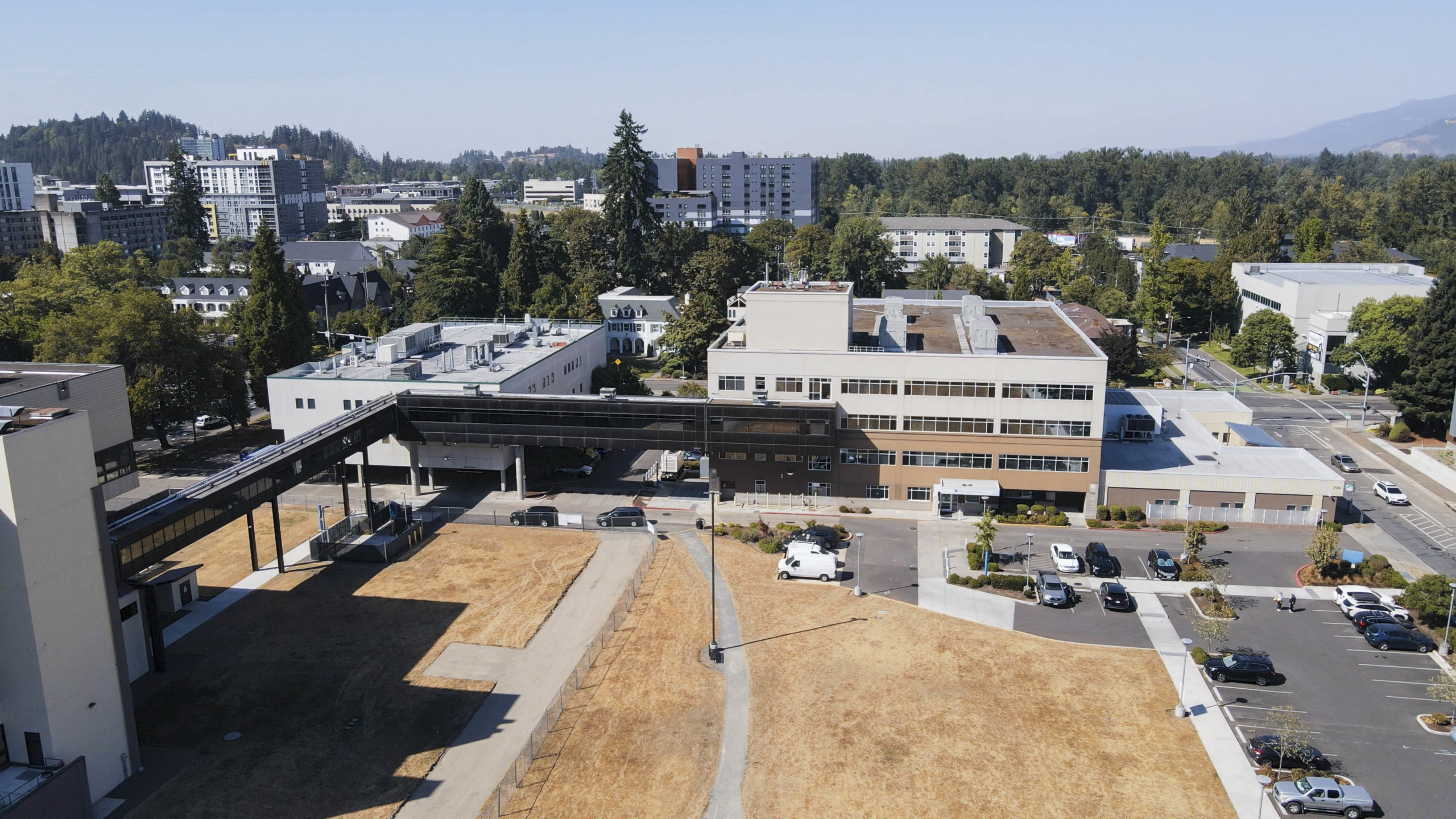
Bushnell University acquired two former PeaceHealth buildings along 11th Avenue in November. The monster, 125,000 square-foot purchase expanded Bushnell’s campus capacity by 151% and is the single largest expansion in the university’s history. Bushnell leaders were not willing to disclose the final sale price.
Director of Development Corynn Gilbert and Vice President for Academic Affairs Reed Mueller recently gave The Register-Guard a tour of Bushnell’s newest assets. Walking through the spaces, colorful tape denotes what will be kept, modified or demolished. By the time the fall 2026 semester starts in August, the mint green walls will be painted to match the university’s color scheme.
Now, Bushnell is preparing to renovate parts the space to house its College of Health Professions.
The expansion comes at a time when healthcare access in Lane County has been strained. In December 2023, the PeaceHealth Sacred Heart Medical Center University District closed, leaving the second largest city in Oregon without a hospital. In October, PacificSource laid off over 300 employees after opting out of continuing to provide Medicaid and Oregon Health Plan management in Lane County. PeaceHealth has laid off portions of its workforce, including leadership positions, three of which were in Lane County. Most recently, PeaceHealth announced it will replace Eugene Emergency Physicians, its longtime emergency room staffing contract holder, with Lane Emergency Physicians, an LLC created by Georgia-based ApolloMD.
“We are not ashamed to say out loud (that) we are the only university in our region responding to the healthcare workforce problem at the bachelor’s and master’s levels,” Gilbert said. “We are sort of sitting alone in this space, and we’re proud of that.”
The college offers three nursing pathways and one graduate mental health degree. With the additional space, Bushnell is looking to branch out.
“(It) allows us to expand our medical education and our premedical education and basic science education in ways we never have dreamed of before,” Mueller said.
The two buildings include the four-story former Support Services Building at 770 E. 11th Ave. that currently houses PeaceHealth’s behavioral health unit and the three-story building at 722 E. 11th Ave., which previously contained PeaceHealth’s Center for Medical Education & Research, as well as Bushell’s nursing program.
Gilbert and Mueller explained the basic plans for most of the floors.
What will Bushnell create inside the University District property this fall?
Before the purchase, Bushnell had leased the second floor of 722 since 2022. The floor has nursing classes and a skills lab, branded with Bushnell colors. By this fall, the third floor will be completely remodeled and ready for students and staff.
Gilbert said the second floor of 722 will be primarily classrooms, while the third floor will house mostly labs. The largest room on the second floor has a joint classroom and skills lab with desks and hospital beds crammed into one space. The nursing skills lab will be transferred upstairs to a room more than twice the size. The lab will hold eight to 10 beds with high fidelity mannequin simulators for the students to practice on.
The expansion also allows the second floor to have a 32-person classroom to fit a full cohort of nursing students.
In addition to the nursing skills lab, the third floor also will have new laboratories for undergraduate biology, chemistry, exercise science, physics and psychology. Gilbert said this will double Bushnell’s lab space for undergraduate students.
“We don’t have to start from scratch,” Gilbert said, noting the space already has built-in gas turrets and chemical fume hoods. “Yes, we need to do a little upgrade, but it’s actually going to cost our university much less than it would have, which means we can meet the need faster.”
Building 722 will house seven faculty offices. Most of these changes to the second and third floor will be complete by fall 2026, but Bushnell has longer-term ideas, too.
“We are dreaming and planning to build out a full, simulated, inpatient hospital floor, with nurses station, four inpatient rooms, surgical, training, the whole thing,” Gilbert said.
“The beauty of having more space there allows us to do different kinds of clinical education,” Mueller said. “So mid-level medical providers – think your primary care providers, not physicians, but other disciplines or practices. Having a larger simulation space allows us to move from a nursing simulation to a college health professional simulation.”
Skybridge and Behavioral Health building renovations to come later
Crossing the skybridge that connects the third floors of the two buildings, Mueller said the window-lined pathway will serve as a communal area. While the other University District skybridges that stretch across Hilyard Street will be removed, Bushnell will maintain the sole remaining skybridge, which offers a view of the Bushnell campus to the north.
Gilbert and Mueller envision posters showing the history of Bushnell and nursing in the space. The third floor of 770 will be primarily dedicated to other initiatives in the College of Health Professions.
Most of the third floor is still in early planning, but Bushnell has bold aspirations – a clinic.
“We’re really excited about the possibility for a shared-use community clinic, in which Bushnell students who are training in health professions could actually serve the community and Bushnell students in an active clinical setting,” Gilbert said. “This space provides a dreaming opportunity for us to imagine how we can directly serve the healthcare needs of our region, right now, while they’re in training.”
Unlike University of Oregon and Lane Community College, Bushnell doesn’t have a health center that offers services to students.
That all could change in the coming months. Bushnell already offers a mental health counseling clinic that serves approximately 150 clients, half of whom are students and the other half of whom are community members. The mental health clinic is staffed by graduate students in the Clinical Mental Health Counseling program.
“It’s not a commitment yet, it’s all in exploration,” Gilbert said. “The enthusiasm that we’re getting from partners, from donors, from the community, from community leadership, from the mayor, it’s just been amazing. Yeah. They all really want us to pull this off, and we know we will.”
The fourth floor of 770 is in active renovation for use in the fall, according to Gilbert. Much of the fourth floor will be used for non-healthcare operations such as arts faculty offices, academic operations, Bible, Theology and Ministry faculty offices, and the new Center for Calling and Community.
The top floor is also home to Bushnell’s new board room, where it has already held its first meeting. The space has a fresh coat of paint and new carpet to match Bushnell’s navy and gold colors.
For now, the first and second floors of 770 are still being used by PeaceHealth for its Behavioral Health Intensive Outpatient and Partial Hospitalization program, but Bushnell leaders don’t mind having a tenant.
“It’s a community service here,” Mueller said. “We can serve the community in a different way.”
PeaceHealth will continue to lease the space until construction is complete on the Timber Springs Behavioral Health Hospital, expected to open in 2027 near the Riverbend campus in Springfield.
How a small, private university hopes to meet Eugene’s healthcare needs
Bushnell has a long history with healthcare in Eugene. In 1924, the college founded Pacific Christian Hospital, which is now the former University District hospital. Sisters of St. Joseph of Newark purchased the hospital from Bushnell in 1936 for $50,000 and renamed it Sacred Heart General Hospital.
Ninety years later, Bushnell is moving back in.
Bushnell’s nursing program has been ramping up in recent years.
In 2016, Bushnell launched its registered nurse to bachelor of nursing science pathway at President Joseph Womack’s insistence. In 2022, Bushnell began offering an accelerated bachelor’s degree in nursing. In 2025, Bushnell began its standalone, traditional bachelor’s nursing program.
Since it started leasing part of 722 from PeaceHealth, 161 nursing students have graduated over six cohorts. Gilbert said 100% of those students passed the National Council Licensure Examination (NCLEX) exam on their first try, the best rate in Oregon. She added of those nursing graduates, 80% are staying in the state and 65% are staying in Lane County.
“We’re super proud of our outcomes,” Gilbert said. “We get to grow all of this when we expand into the entirety of the building.”
Outside of nursing, Bushnell is looking to land a foothold in other aspects of healthcare.
In fall 2026, Bushnell is launching a bachelor’s degree in public health. Further down the line, the university is looking to launch another undergrad program that would serve as a pipeline for behavioral health and wellness practitioners.
Bushnell is exploring degree pathways for mid-level providers such as physician associates, nurse practitioners and other advanced practice nursing.
With the success of the nursing program, Bushnell leaders are hoping other healthcare professional graduates will remain in the area and help fill provider gaps. Mueller said the university will be engaging in the community to figure out what needs exist and how the school can fill those needs through educational programs.
“We care about the whole system,” Mueller said. “We (want to) build a system that will not only serve the needs of today, but that grows into the future to serve the needs of tomorrow.”
Miranda Cyr reports on education for The Register-Guard. You can contact her at mcyr@registerguard.com or find her on X @mirandabcyr.