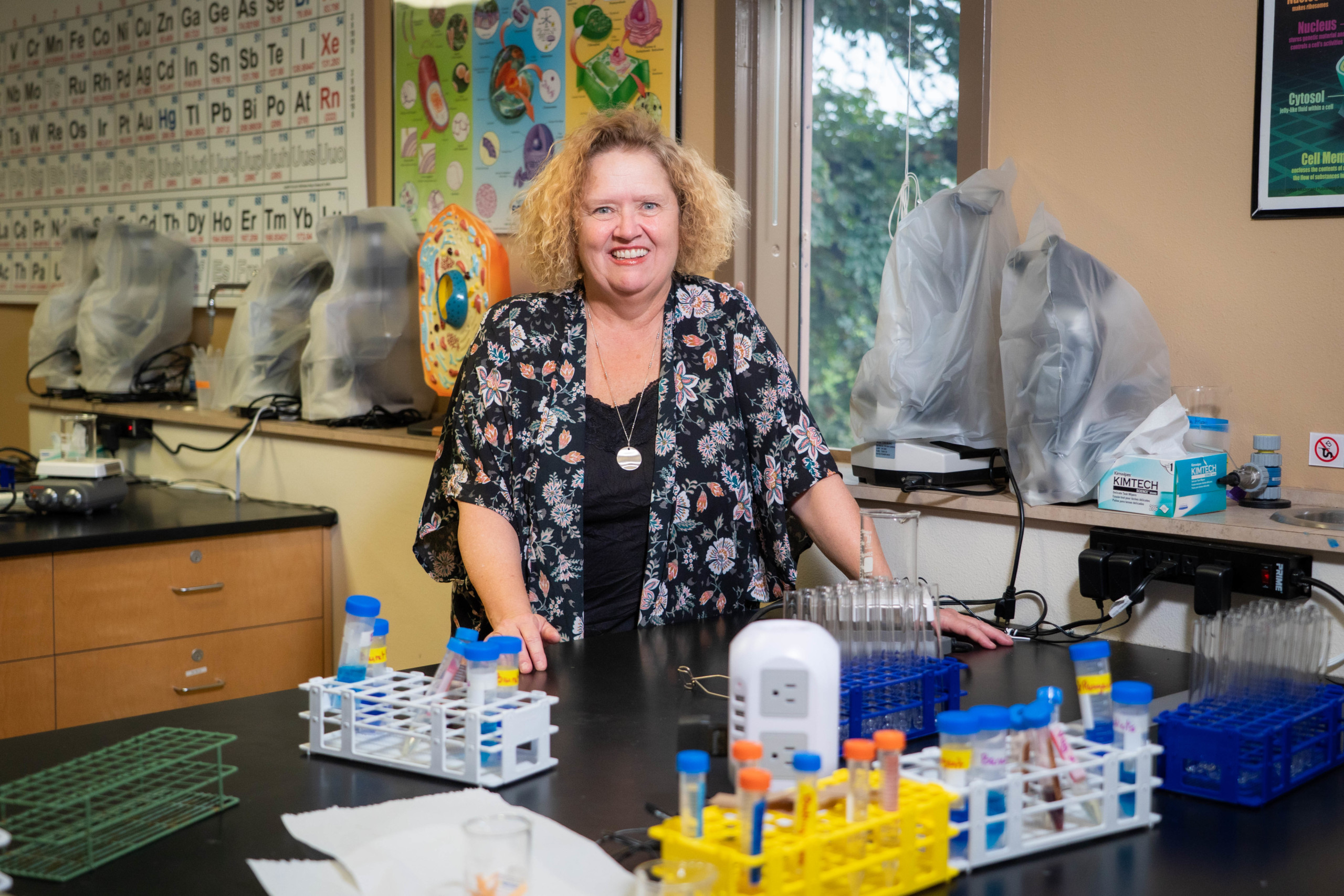
Biochemistry professor Pamela Beilby did not set out to become a professor. As a child, she imagined herself as a cowboy, an astronaut, or a detective, roles defined by exploration and discovery rather than classrooms and lecture halls. Teaching entered her life later, almost incidentally, during graduate school, when she first began working closely with students. Explaining complex ideas in comprehensible ways and mentoring individual students sparked something unexpected. “It wasn’t actually until I got into graduate school and had the opportunity to start working with students that I really found a love for teaching,” she recalls. What began as a detour became a clear sense of calling, one that brought her to Bushnell University.
As is often the case with calling, it builds upon our strengths and passions. Bielby’s career involves scientific exploration and discovery, harkening back to her excitement to uncover life’s mysteries and meaning.
Bielby earned a Ph.D. in biochemistry and biophysics from Oregon State University and a master’s degree from Portland State University. Before joining Bushnell, she taught at several colleges and universities across the Willamette Valley. These experiences shaped her instructional approach and her commitment to undergraduate learning. Yet credentials, she emphasizes, are only part of the story. Her vocation took shape not in isolation, but through sustained interaction with students, particularly those encountering science outside their intended fields of study. She strives to show students how the molecular foundations of life impact us every day through myriad ways.
We caught up with Beilby to learn more about her approach to teaching, her reflections on seeing life at the molecular level, and the perspective she offers students as they consider how science intersects with vocation and calling.
Seeing Life at the Molecular Level
Much of Beilby’s teaching centers on helping students see biochemistry not as an abstract requirement, but as a lens for understanding life itself. “As a biochemist, you’re really looking at life down at the molecular level,” she explains. In that microscopic focus, she finds both intellectual rigor and wonder. She often points to enzymes as an example: molecules so precisely structured that they recognize and interact with only one specific counterpart, even when alternatives appear nearly identical. That specificity, she says, reveals “this amazing design, this incredible amount of order.”
Seeing order in life’s smallest details stems from Bielby’s worldview, one that finds a home at Bushnell. She takes joy in sharing the chemistry of this amazing world that God has created and helping others understand how this plays out in practical ways. She regularly connects molecular structure to real-world implications, such as how food becomes cellular energy, how small changes in amino acid sequences can lead to disease, and how pharmaceutical compounds are designed to target specific enzymes. From agriculture and nutrition to medicine and public health, biochemistry, in her words, “is everywhere.” Teaching non-majors early in her career sharpened her ability to communicate these connections clearly, helping students appreciate science as something relevant to their lives, regardless of their chosen discipline.
Her approach reflects a conviction that understanding fosters curiosity rather than intimidation. She delights in the challenge of making complex material accessible without oversimplifying it, inviting students into the discipline rather than positioning it beyond reach. That posture of being patient, attentive, and invitational has become a hallmark of her classroom.
Teaching, Calling, and Student Formation
At the heart of Beilby’s work is a deep care for students as individuals navigating questions of vocation and purpose. “I love working with students,” she says simply. Her hope is not only that they master course content, but that they gain clarity about where they are being called. Biochemistry, she notes, equips students for a wide range of futures, offering tools and ways of thinking that remain useful no matter the path they pursue.
Her own journey informs that perspective. Teaching was not part of her early plans, yet it emerged through experience, mentorship, and openness to redirection. She encourages students to remain attentive to similar moments in their own lives and to pay attention to what energizes them and where they find meaning, even when it differs from their original expectations.
Beilby’s academic interests extend beyond the classroom. When time allows, she participates in research examining glutathione, mitochondrial function, and age-related neurodegeneration, with implications for pharmaceutical development. While her current focus at Bushnell is teaching, this ongoing engagement with research reinforces the connections she draws between foundational science and its broader applications.
For students wrestling with demanding coursework or uncertainty about the future, her advice is grounded and pastoral: pursue excellence, remain curious, and trust that clarity often comes through faithful engagement rather than immediate certainty. Success, in her view, is not a single outcome but a process of learning to follow where one is being led.
Learn More
Beilby teaches biochemistry and chemistry courses within Bushnell University’s School of Arts and Sciences, supporting students across majors as they explore the molecular foundations of life and health. To learn more about programs in the sciences, visit Bushnell University’s School of Arts and Sciences.