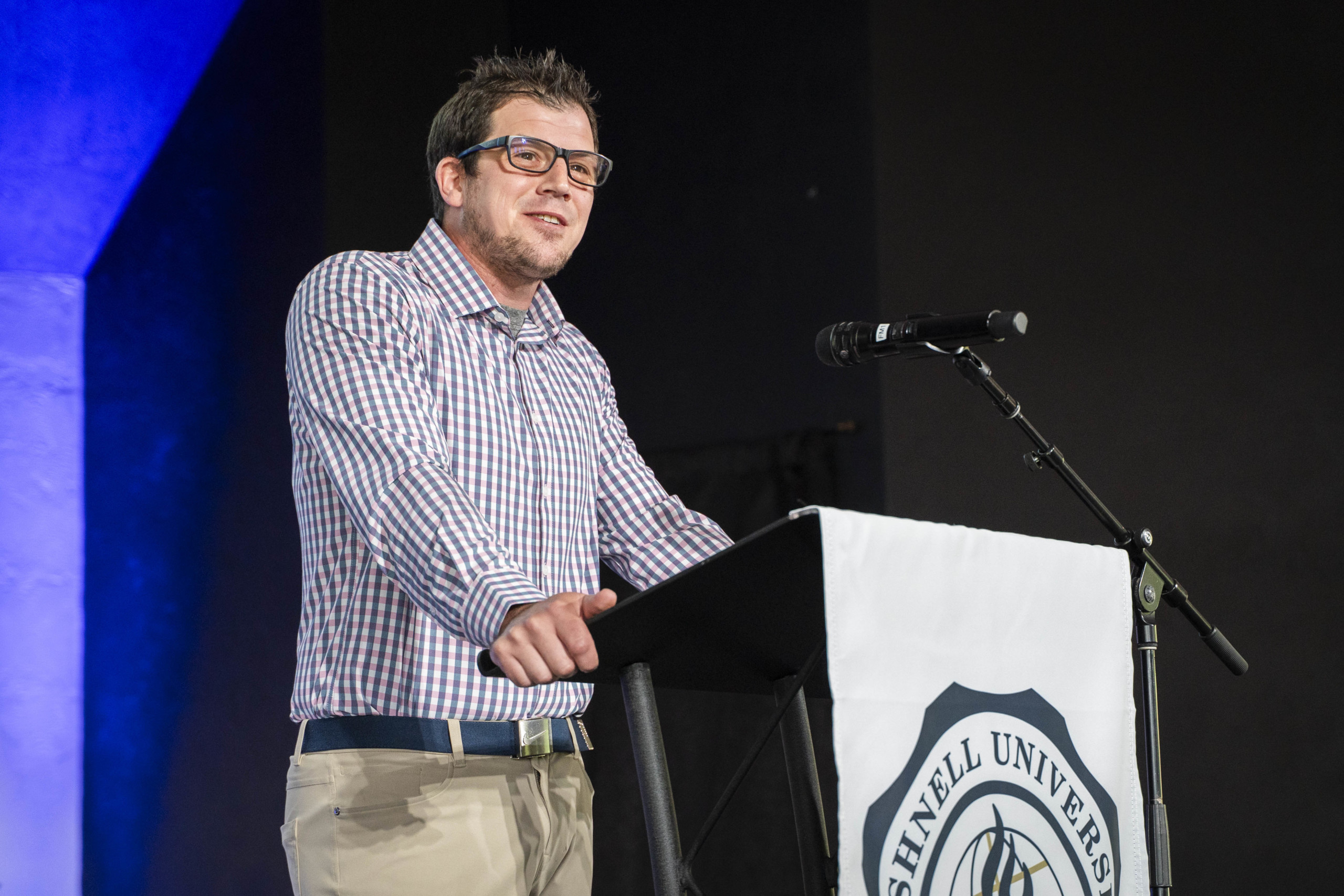
Assistant Professor of Biblical Studies and Christian Formation Joshua Little has always experienced learning as something meant to be shared. “Whatever I’m learning is something that I also want to communicate,” he says. Whether reading Scripture, working through a theology text, or reflecting on his own life, he finds himself asking the same question: How can I help others understand this? That instinct, present for as long as he can remember, now shapes his daily work at Bushnell University.
Little teaches in Bushnell’s School of Bible, Theology, and Ministry, where he leads courses in biblical studies, including Classical Hebrew, Bible survey classes, and electives focused on specific books of the Bible. He holds two master’s degrees from Wheaton College, one in biblical exegesis and one in Christian formation and ministry, and is currently pursuing a Doctor of Ministry in leadership and spiritual formation at Portland Seminary. He also serves as Lead Pastor of Westside Faith Center in Eugene, Oregon, a role that reinforces his commitment to ensuring that Scripture is encountered not only as text to be studied, but as truth to be lived.
Yet for Little, credentials and content are never the center of the story. His subject matter is faith itself, and he is keenly aware of the risk that Scripture can become detached from lived experience. “I don’t ever want the Scriptures to just be subject matter,” he explains. “I don’t want them to just be content that I’m trying to communicate or formation to just be like an idea.” Instead, he aims to teach from a cultivated and sincere life of faith, bringing to the classroom not only academic preparation but personal conviction.
We caught up with Little about his approach to teaching biblical studies and spiritual formation, how he seeks to unite careful study with lived faith, and the perspective he offers students as they wrestle with Scripture and their own growth during their years at Bushnell.
Bridging Classroom and Real Life
Little cares deeply about holding together two commitments: careful study of the Bible and intentional spiritual formation. He recognizes how easily biblical studies can be reduced to analysis alone. “We can lose our focus on what matters the most, and we just turn the Bible into an academic subject,” he says. For him, spiritual formation serves as a necessary companion, continually asking how the text speaks into ordinary life.
That integration shapes the way he approaches each course. If he is doing his job well, he says, he is “helping bridge the gap between classroom and real life.” He wants students to see that what they are learning is not confined to exams or papers, but speaks directly to their questions, relationships, and decisions. In academic settings, it can be easy for students to experience a disconnect between theory and practice. Little works to ensure that Scripture is encountered not only as literature to be studied, but as truth to be lived.
This posture also informs the way he presents himself to students. Teaching faith, he believes, requires more than clear lectures. It requires being present. He hopes to convey his convictions “through not just the way that I teach but the way that I am with students as well,” modeling a life in which study and devotion are inseparable.
Walking Alongside Big Questions
While Little enjoys the classroom, he is quick to name relationships as the most meaningful part of his work. “Really, my favorite part of the job is actually just the relationship building with students,” he says. Office hours, conversations after class, and unhurried discussions about life and belief often matter as much as formal instruction.
College represents a particular season of questioning and growth, and Little does not take that lightly. He values the opportunity to sit with students in their “real questions” and tensions, accompanying them as they wrestle with large ideas and personal uncertainties. “Getting to walk alongside students while they’re doing that is probably my favorite part of the job,” he says.
For students, his advice is implicit in the way he teaches: do not separate what you learn from how you live. Allow Scripture to shape not only your understanding but your daily life. Ask how what you encounter in the classroom speaks to your decisions, relationships, and sense of calling.
Little’s work reflects the broader mission of Bushnell’s School of Bible, Theology, and Ministry, where biblical study and spiritual formation are pursued together. To learn more about programs in biblical studies and Christian formation, visit Bushnell University’s School of Bible and World Christianity.
Learn More
Little teaches biblical studies and spiritual formation courses within Bushnell University’s School of Bible, Theology, and Ministry, equipping students to engage Scripture thoughtfully while cultivating a life of sincere faith. To learn more about programs in biblical studies and Christian formation, visit Bushnell University’s School of Bible, Theology, and Ministry.