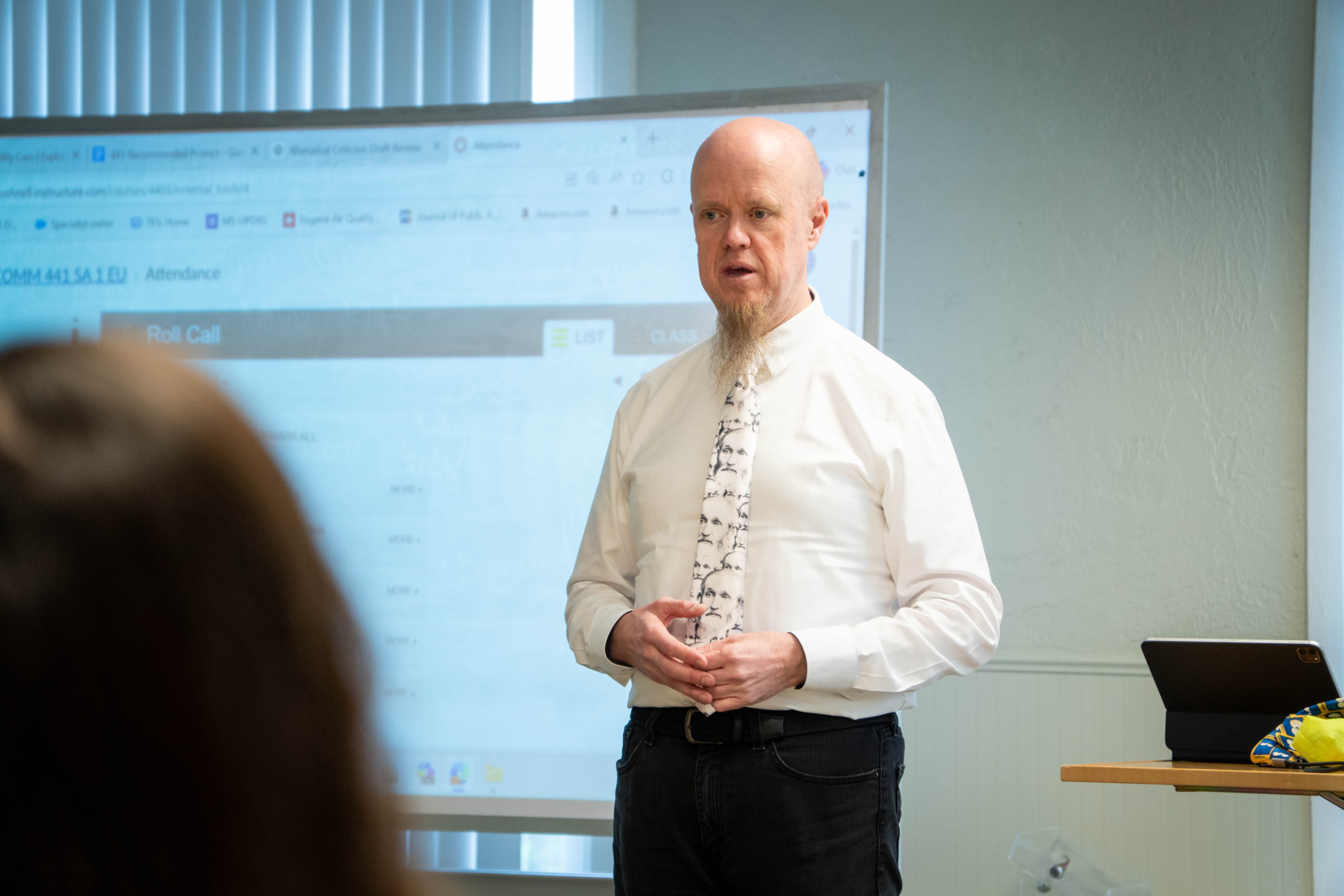
Dr. Doyle Srader remembers the moment his understanding of his own life changed: not during a major achievement, but in an ordinary classroom conversation. A student looked at him and said, “You’re the happiest person I know.”
“I said, ‘What are you talking about? I’m not happy,’” he recalls. “And then I stopped and thought, I actually am happy.”
That realization marked a turning point. After years spent pursuing debate at the highest levels, including a national championship at Baylor University and a position as a debate coach at Arizona State University, Srader had reached a place of burnout. Teaching public speaking had been a temporary solution, something to do while he reconsidered his direction, but in that moment, it became something else entirely. “That’s when I decided, okay… teaching is what I should be doing.”
Today, Srader serves as a speech and communication professor in Bushnell University’s School of Arts and Sciences. He has taught at Bushnell since 2007, leading courses in public speaking, interpersonal communication, and listening behavior, while also advising communication majors and supporting campus academic initiatives. He holds a Ph.D. in speech communication from the University of Georgia and a master’s degree from Baylor University.
Teaching That Builds Confidence
In Srader’s classroom, progress often begins with hesitation. Many students enter his public speaking course unsure of their ability, carrying a quiet expectation that they will struggle. What matters to him is not where they start, but what unfolds over time. “What I love is when students come in not believing in themselves, but determined to keep trying and not give up,” he says.
Over the course of a semester, that persistence begins to shift how students see themselves. “What they discover over those 15 weeks is that they are better at it than they thought they were and that they have a new strength and a new capacity,” he explains. Having taught the course more than 120 times, Srader still finds meaning in watching that change take place. “I get to be in the front row seat and see students grow into themselves, and the confidence that comes with that.”
That same focus carries into his courses on interpersonal and relational communication. Srader addresses a different challenge he sees shaping student experience: loneliness. Drawing on research about the impacts of loneliness, he frames communication as a set of practices that can be learned and applied. “This is how you start a relationship, this is how you maintain one, this is how you navigate conflict, this is how you become a better listener,” he says. The aim is practical and immediate. “I know what I’m arming them with to bless themselves and also everybody around them.”
Formation Through Persistence
Srader’s perspective is grounded in his own academic journey, which did not follow a straightforward path. “I graduated in the bottom half of my high school class,” he says, noting that he also failed courses in college. Those experiences shape how he responds to students who hesitate to try something new for fear of failure. He recognizes that same anxiety and works to reframe it, encouraging students to remain engaged even when success is uncertain.
At the center of his teaching is a broader understanding of purpose: “What I have come to realize, and what I really want all my students to realize, is God is moving in the world and God privileges us to be part of what He is doing.” That belief informs how he approaches each class and each interaction. “Every interaction with a student… God is working in that person’s life.”
He has brought this message abroad as well. During the 2022–23 academic year, Srader served as a Fulbright Scholar in Japan, becoming Bushnell’s first Fulbright Scholar. He taught courses on communication, conflict, and argumentation at multiple universities. He continues that engagement as a Fulbright Specialist, sharing expertise in areas such as listening and public speaking.
For students, his advice is simple: continue moving forward, even when outcomes are uncertain. Growth, he has found, often begins with the willingness to try and to keep trying.
At Bushnell, that same approach is reflected in communication courses within the School of Arts and Sciences, where students build the skills and confidence to engage effectively with others in both personal and professional contexts.